CONCEPTUAL WORKS
An appetite for experimentation, a desire to break institutional boundaries, a tendency for site-specific work and a sudden interest in etno-botanics. From 2014 to 2017, as an Art Student in London I was blooming with inspiration and had all the support I needed to constitute the base of my artistic practice. These are some of the images and thoughts that originated in that period.
Botanical Identity, 2016
Frontier Economis Comission
Botanical Identity a data based weaving that displays a list of 21 different plant species ordered according to how many times they were mentioned by the participants of a survey. It is a parallel between cultural diversity and biodiversity, an ethnobotanical manifesto that reminds us how much we have in common.
The context is the pre Brexit London, 2016. Part of the country is worried about the migration crisis and is about to vote a referendum to exit the European Union and not having to share the responsibility to deal with it.
In the meantime, as a migrant myself, I was interested in how the British empire collected different plant species around the world and the impact on biomes, cuisine, medicine and habits inside the UK and overseas.
Frontier Economics - a multinational company based in Holborn, London - invited Chelsea College of Arts students to apply for a comissioned project with them. I was interested in the variety of cultural backgrounds among the staff, but I didn't want to know the name of their countries. Instead, I asked them to give me the name of at least 3 plants that were part of their cultural heritage.
My project was chosen and, based on information provided by them on a survey, I gathered over 70 names and sourced the top 21 most mentioned plant species to use them as a material for the weaving.

Woven cotton and herbs on copper frame. 100cm x 100cm.

Woven cotton and herbs on copper frame. 100cm x 100cm.
Woven cotton and herbs on copper frame. 100cm x 100cm.


Bricks, 2015 - 2016
This work emerged as a proposal for the Picton Art Prize during the summer of 2015 and has been developing ever since. It involves questions of form, materiality, temporality and transformation.
The decision to use bricks in this sculpture is based on the fact that most of the architectural heritage of London is made of bricks. They have also been used in literature as a methaphor for standardization, social control. The unfired bricks containing seeds, challenge the idea of control and are suposed to nurture transformation. Interested in the idea of refusing control, I inted to join the viewer in contemplating what the sculpture can transform into.
Is it possible for a sculpture not to stand for control or any other kind of violence? Can it welcome time's action upon it? How does the viewer relate to it, knowing it will be different the next time they see it?
Materiality:
An oval shaped structure made of 360 bricks - half industrially produced and half handmade out of clay, soil and seeds.
Initial of the Sculpture in metres:
1,96L x 1,24D x 1,24H
Experiments:
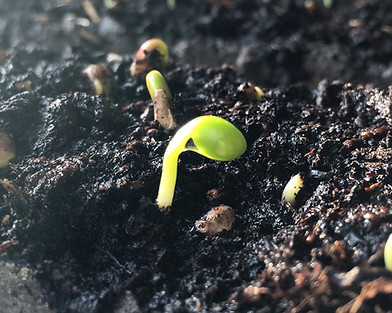
Determined to test the idea in a smaller scale, I gathered several kinds of seeds and mixed them with soil and clay in different proportions. All of them sprouted and grew whilst being watered. During winter they were left at the studio and dried out, but months later, they were placed outside and bursted with life.
This will remain as a proposal until it finds the basic conditions to exist.


Take Care, 2016
This piece was made for the Interim Show on the 15th of February. It consisted on an object to be given away at the exhibition. Visitors could have the object only after signing a contract in which they agreed to document any changes occured to the object within a month and sent it back as any kind of documentation.
A report was made with the documentation sent by the "beholders".


Performing installation Clay, seeds, contract, table.


Off Site, 2016
The Off Site Show happened in in Peckham at the Safe House Gallery in May 17 as part of Chelsea College of Art's Graduate Diploma program. Encouraged to work site specifically, I brought a weaving loom to the gallery and produced a tapestry throughout the duration of the show.
Visitors were asked to bring something from their journey to the gallery and the found objects were incorporated into the piece.
This process trigerred a few conversations around what could be taken from the streets and things that don't belong to anybody or anywhere. Some participants were confused about what they could bring and whether I would accept it. The weaving took 13 hours and received 13 objects. All objects the visitors brought in were incorporated. No exceptions.
*During the exhibition I was told the last person who lived in the house used to be an avid weaver.


Seeds for Stories, 2016
Exchange/ Film, 5:00 min.
Intrigued by the various ways in which the Old English Garden has been used by the public and the stories it has witnessed in over a century of existence, I proposed an exchange to the visitors of the garden: Seeds for stories, conversation, memories. As I interviewed 21 people and explored intersections between public and private memories, stories were recorded and written on paper.
Seed packets were suspended on a line above a bench and as each interview ended, the packet was replaced a sheet with notes and doodles from the interviews.
This event was part of the Thrive Battersea program in the Chelsea Fringe Show 2016 from the 25th to the 29th of May. It existed as an artistic practice of exchange and also produced content for a film. This 5 minutes version was presented as a projection in the 2016 Graduate Diploma Degree Show at Chelsea College of Arts.
In this film, images of the garden and the voices of interviewees give us a hint of who they are what this place means to them.


Documentation of visit made on 11/03/2016.